 |
| Pen and ink drawing by J Walton dated 1991 bottom right corner |
Tuesday, March 13, 2012
Pen and Ink drawing of Stansted School by J Walton 1991
This is a sweet little pen and ink drawing of the original Victorian school, dated 1991 (the school has since been extended in 2006). It currently hangs in the school. I don't know who J Walton is, or why he/she drew it. If anyone has any information please comment.

Old photographs of Stansted School pupils
These photographs are copies of those found in the Fairseat and Stansted Historical Society's archives. They are not presented in any order and any dates have been taken from the Society. In case you don't know about this society, their archive is stored in Fairseat Village Hall.


 |
| Headmistress Mrs Murphy. Stansted resident Mick Osbourne also present |

 |
| For the 1974 centenary celebrations the children dressed as Victorians |


 |
| 1975 |
 |
| 1954 |
 |
| Mrs Murphy again |
 |
| 1976 |
 |
| 1981 with teacher Mrs Hale |
 |
| 1981 with Mrs Joyner (headmistress) |

 |
| 1974 Rejoicing after the school was reprieved from closing |
 |
| About 1910 |
 |
| Caption for above photo |

 |
| 1920 or 1928? |
Stansted War Memorial
This rather unusual and lovely war memorial stands on a small triangular island at the bottom of Stansted Hill.
There is much to read about Stansted War Memorial if you click the link below.
Stansted War Memorial
Here is a brief excerpt.
Regarding the above theft, local legend has it that the thieves pulled the statue down with a vehicle and dragged it up Malthouse Lane, apparently leaving gouged scratches all along the road's surface. It must have made a hell of a racket, but it was the dead of night so no one heard it!
I found a rather wonderful (and long!) document detailing all the fallen on the web, and I've recreated it here for you to look at. As I'm not the author I cannot vouch for its accuracy, but if anything is incorrect I sincerely hope it causes no offense.
The War Memorial is listed, see here


There is much to read about Stansted War Memorial if you click the link below.
Stansted War Memorial
Here is a brief excerpt.
The original bronze memorial statue was by the sculptor Alois Stroebl and was cast in Budapest. The base is Portland Stone. The Memorial was finally erected and unveiled in 1923.
Since 1923, the statue has been twice stolen. On the first occasion in 1964 it was recovered from a quarry in Dartford, but the second time in 1995 it was finally lost and never recovered. The replacement of today was prepared by the modern sculptress, Faith Winter, and erected in 1996.
Since 1923, the statue has been twice stolen. On the first occasion in 1964 it was recovered from a quarry in Dartford, but the second time in 1995 it was finally lost and never recovered. The replacement of today was prepared by the modern sculptress, Faith Winter, and erected in 1996.
Regarding the above theft, local legend has it that the thieves pulled the statue down with a vehicle and dragged it up Malthouse Lane, apparently leaving gouged scratches all along the road's surface. It must have made a hell of a racket, but it was the dead of night so no one heard it!
I found a rather wonderful (and long!) document detailing all the fallen on the web, and I've recreated it here for you to look at. As I'm not the author I cannot vouch for its accuracy, but if anything is incorrect I sincerely hope it causes no offense.
The War Memorial is listed, see here
 |
| A close up of the face |


 | |
| The statue is part of Stansted School's logo |
Fairseat Post Office and Fairseat Cottage - old postcards and recent photo
 This photo and the one below show two old images of the Fairseat Post Office found for sale on Ebay, although the more I look at the picture on the left the more I can't marry it up with the building which is there today! (Edit - see comment below, this picture has now been identified as Fairseat Cottage. Can anyone confirm that this was once the Post Office?)
The other photo below is very obviously the Old Post Office taken from the road in front of the pond. The hedge today is much higher, and you can barely glimpse the house from the road.
There is a plaque on the wall (photo at bottom) to commemorate the old post mistress, Stella Henden, who served the community for 50 years. She must have been a very popular person to have had a plaque put up. She died in 1966.
This property, which is next to Fairseat Village Hall grounds, has now been much extended and renovated.
It has had three different owners since I've lived here. I found this information below on a property site.
'The Old Post House is a delightful flint stone house believed to date in part from the 16th Century and understood at one time to have been cottages with a barn, and the village telephone exchange.'
There I also found the modern photo (bottom) which shows you how it looks today, although it is taken from the back of the house. I am mystified as to how this photo was taken as it's from quite high up, and as far as I'm aware there is nothing you could climb on to get this shot - perhaps they went up in a hot air balloon!
The ex Conservative MP John Carlisle and his wife Anthea lived here for a few years in the noughties. I see that since moving they have arranged for a nice new wooden village notice board to be erected in place of the rather old and worn one.


There is a third 'Old Post Office' in Fairseat, the pink house on the road next to the pond (see below) - it's called Fairseat Farmhouse. There is a post box embedded in the front wall, now painted black. This was in use up until fairly recently, I think it may have closed in the '80s. I met the previous occupant, a lovely lady called Melita Gandolfo, and I'm pretty sure her mother called Kay was the last person to run the Post Office. They moved out approx. 2012 or early 2013. (EDIT 2017: Fairseat Farmhouse is now hugely modernised, extended and no longer pink.)


Fairseat House - old postcard
Back and front of a postcard which was being sold on Ebay. Copy on the back reads
To my dear Annie
With love and best wishes from your loving sister Elsie xxxxx
This is only one side off (sic) it
I believe Fairseat House was a convalescent home for children. Perhaps this was from one of the children staying there.


To my dear Annie
With love and best wishes from your loving sister Elsie xxxxx
This is only one side off (sic) it
I believe Fairseat House was a convalescent home for children. Perhaps this was from one of the children staying there.


Trosley Towers (demolished) and Sir Sydney Waterlow


Sir Sydney Waterlow, politician and philanthropist, was a commissioner at the Crystal Palace Exhibition and was director of the Union Bank of London. He became Lord Mayor of London in 1872 (see caricature which appeared in Vanity Fair on 9th November 1872, below left). He was buried in Stansted churchyard in 1906. There are some pictures of his grave here. I have also found an undated document describing the damage to his grave, you can read it here. It was generated by pmsa.com (Public Monuments and Sculpture association).
There is a Wikipedia entry for Sir Sydney here.
In the 1870’s Sir Sidney purchased large areas of land including the Village of Fairseat, a good proportion of Stanstead together with land from Wrotham to Meopham. The parts of the estate were linked by a small bridge bearing the family crest over Vigo Hill still in evidence today.
In 1887 he built Trosley Towers on the crest of the escarpment to the east of Trottiscliffe Road. It was approached by two drives and was surrounded by wooded grounds. Other private drives were constructed, one of which is Hamilton Drive which still survives in Trosley country Park and runs from the site of the old House to Commority Road.
Sir Sidney died in 1906 and the estate passed to his son Sir Philip. When he died in 1931 the estate was sold off. Some of the houses were bought by tenants, one of these was Pilgrims House, with six acres of land, at the bottom of Trottiscliffe Road which went for £600. Trosley Towers and the woodlands were sold to Mr E. E. Shahmoon in 1935, this was also the time of the chalet building.
In 1936 Mr Shahmoon had Trosley Towers demolished and had Hamilton Lodge built along with adjoining stables. One story suggests that the Lodge and stables were built to accommodate the Shah of Persia and his racehorses on his visits to England.
The whole area was still owned by Mr Shahmoon when it was taken over by the army 1942 and Hamilton Lodge was to be the HQ of the Brigade that was stationed here.
Click for source of copy and interesting information about Vigo's history


 |
| The bridge over Vigo Hill |
Daphne Oram of Tower Folly, Fairseat

Educated at Sherborne School For Girls, Oram was, from an early age, taught piano and organ as well as musical composition. In 1943 she was offered a place at the Royal College of Music but instead took up a position as a "music balancer" at the BBC. During this period she became aware of developments in "synthetic" sound and began experimenting with tape recorders. She also spent some time in the 1940s composing music, which remained unperformed, including an orchestral work entitled "Still Point".
In the 1950s she was promoted to become a music studio manager and began to campaign for the BBC to provide electronic music facilities for composing sounds and music, using electronic music and musique concrète techniques, for use in its programming. In 1957 she was commissioned to compose music for the play Amphitryon 38. Using a sine wave oscillator, an early tape recorder and some self-designed filters, she produced the score from only electronic sources; the first of its kind at the BBC. Along with fellow electronic musician and BBC colleague Desmond Briscoe, she began to receive commissions for many other works including a significant production of Samuel Beckett’s All That Fall. As demand grew for these electronic sounds, the BBC gave Oram and Briscoe a budget to establish the BBC Radiophonic Workshop in early 1958. In October of that year, she was sent by the BBC to the "Journées Internationales de Musique Expérimentale" at the Brussels World’s Fair (where Edgard Varèse demonstrated his Poème électronique). After hearing some of the work produced by her contemporaries, she decided to resign from the BBC less than one year after the workshop was opened, hoping to develop her techniques further on her own.
In 1959 she installed her Oramics Studios for Electronic Composition in Tower Folly, a converted oast house at Fairseat, near Wrotham, Kent. Her output from the studio, mostly commercial, covered a far wider range than the Radiophonic Workshop, providing background music for not only radio and television but also theatre and short commercial films. She was also commissioned to provide sounds for installations and exhibitions. Other work from this studio included electronic sounds for Jack Clayton's 1961 horror film The Innocents, concert works including Four Aspects and collaborations with opera composer Thea Musgrave.
In February 1962 she was awarded a grant of £3500 from the Gulbenkian Foundation. These funds supported the development of the Oramics drawn sound technique. A second Gulbenkian grant of £1000, awarded in 1965, enabled the Oramics composition machine to be completed. The first drawn sound compositions using the machine had been recorded by 1968.
Throughout her career she lectured on electronic music and studio techniques. In 1971 she wrote An Individual Note of Music, Sound and Electronics which investigated electronic music in a philosophical manner. Besides being a musical innovator her other significant achievements include being the first woman to direct an electronic music studio, the first woman to set up a personal studio and the first woman to design and construct an electronic musical instrument.
In the 1990s she suffered two strokes and was forced to stop working, later moving to a nursing home. She died in 2003, aged 77. After her death a large archive relating to her life's work was passed to the composer Hugh Davies. When Davies died in 2005 this material passed to Sonic Arts Network. Daphne Oram's family have now agreed that the archive will reside at the Music Department of Goldsmiths College in London where it will be made open for public access and ongoing research from February 2008 onward. In 2007, a compilation of her post-BBC music, entitled Oramics, was released. User-contributed text is available under the Creative Commons By-SA License and may also be available under the GNU FDL.
Click here for source of copy, plus some interesting photographs
Click here for a clip from the BBC about Oram and her fabulous music making machine
Click here for more information and pictures
 |
| Daphne Oram in her studio in Tower Folly |
 |
| Daphne Oram in the garden at Tower Folly |
 |
| Oramics Studio, headed paper |
 |
| Tower Folly when it was called Ye Olde Hop Oaste - no date |
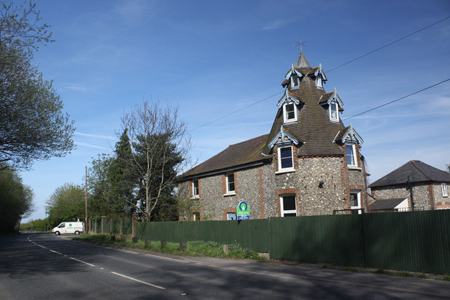 |
| A recent picture of Tower Folly, (opposite the turning to Fairseat Nursery) |
Subscribe to:
Posts (Atom)